Conversion rate optimization agency

Most CRO starts with the page. We start with your brand: the argument you make to buyers, the moment they decide, and the places your site contradicts it. We’re senior-led, brand-first, and we measure our work by revenue.

Brand strategy first
Senior-led
35+ years
Featured in Forbes

Tools and stack

We work with most major CRO and analytics tools and adapt to whatever your team is already using.

  • Testing platforms: VWO, Optimizely, Convert, AB Tasty.
  • Heat mapping and session recording: Hotjar, FullStory, Microsoft Clarity, Mouseflow.
  • Analytics: GA4, Google Search Console, server-side analytics, custom event tracking.
  • Ecommerce: Shopify, Shopify Plus, WooCommerce, BigCommerce, Magento, custom builds.
  • Site speed and Core Web Vitals: PageSpeed Insights, WebPageTest, Chrome User Experience Report data.

The tools matter less than the strategy behind them. We pick what fits your stack and your traffic volume.

What our CRO agency services cover

On-page CRO

The headlines, layout, copy, and design choices on individual pages. We test what your brand actually says, watch where buyers stall, and find what’s breaking trust.

A/B testing

Controlled experiments that compare variations against a baseline. We test hypotheses tied to brand strategy, not the button-color guessing game that many agencies present as CRO.

Heat mapping

Visual data on where visitors click, scroll, and bail. We use heat maps to identify dead zones and design tests based on what we see.

User journey mapping

How buyers actually move through your site from first touch to a purchase. We map the journey, find where it breaks, and rebuild what isn’t working.

Funnel optimization

Top-to-bottom funnel analysis covering where visitors enter, stay, or convert. We rebuild around what the data shows.

Landing page optimization

Standalone landing pages built and tested for specific campaigns or buyer segments. Faster conversion lift than redesigning entire sites.

Ecommerce CRO

Product page, cart, and checkout optimization for e-commerce brands. The work cuts cart abandonment, lifts average order value, and protects margin on whatever you’re spending on paid traffic.

Form and checkout testing

Where visitors quit before converting, we strip friction from forms and redesign checkout flows. Field-by-field testing finds what actually moves submissions.
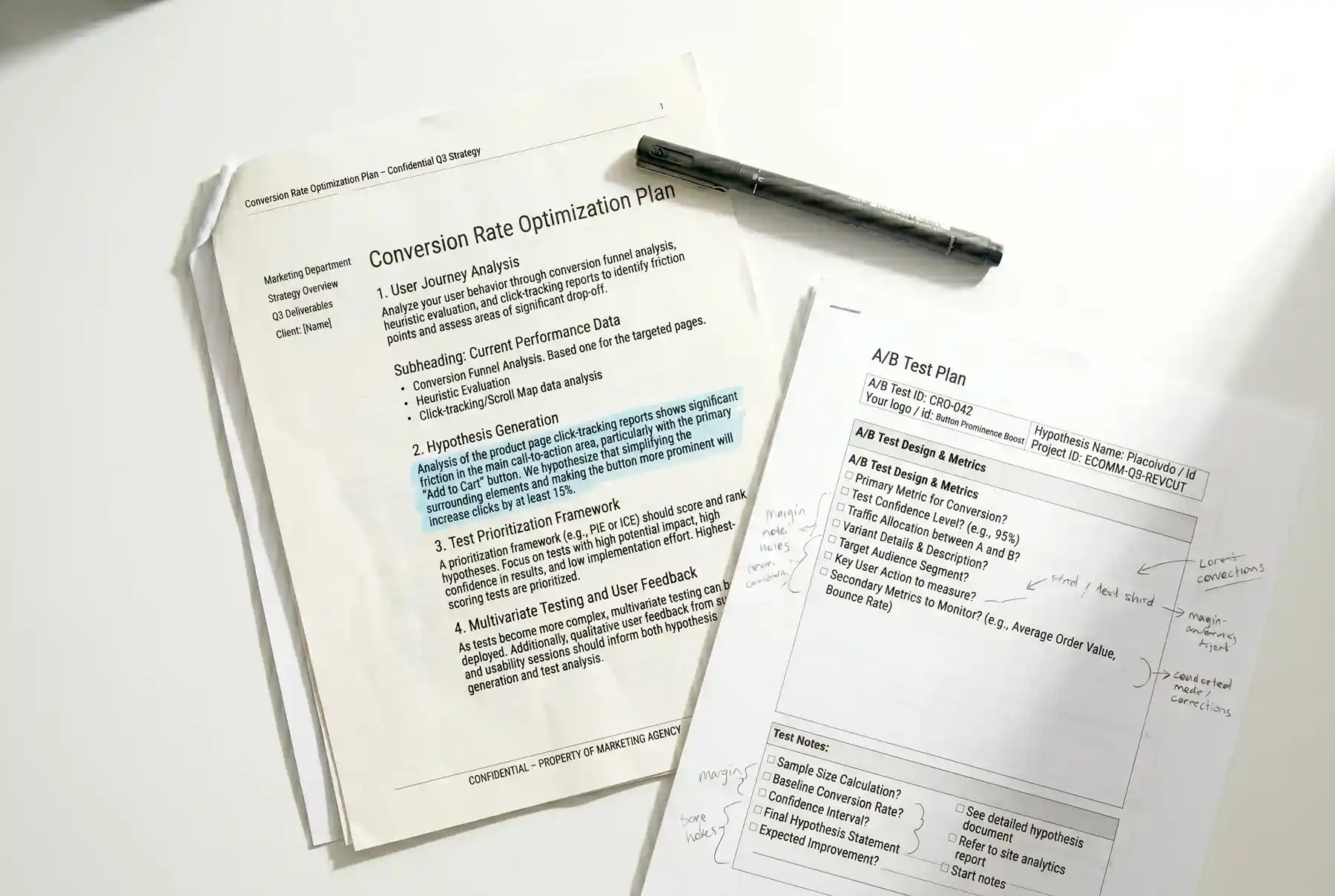
Stack of printed marketing documents on a white desk, including a 'Conversion Rate Optimization Plan' with a blue-highlighted section and a pen resting on top.

Brand-led CRO is different

Most CRO firms run mechanical tests: change the button color, swap the headline, measure the lift. That work delivers a few percent here and there. It also avoids the harder question: why isn’t your buyer converting in the first place?

Brand-led CRO starts with the brand argument. What are you promising? What does the buyer have to believe before they act? Where does the actual experience break that trust? We design tests around those answers, not whatever the testing tool wants to try this week.

The result is bigger lifts that compound. You get the small wins everyone else gets, plus the structural wins from fixing what’s actually broken.

Why most CRO programs underperform

When companies bring us in to clean up a stalled CRO program, the same patterns keep showing up.

Tests run on the wrong elements. The agency tested ten button colors and five headlines, all of which moved conversion by less than 2%. Nobody tested the real friction: a confusing pricing page, a form that asks for fields buyers don’t want to give, and a checkout that fights mobile users.

Hypotheses aren’t tied to anything. The agency runs whatever the testing tool recommends or whatever the team has time for that week. There’s no underlying strategy connecting tests to business outcomes, so the wins don’t add up to anything reflected in revenue.

Reporting hides the truth. The agency reports test wins in isolation (“CTA color test produced a 12% lift”) but doesn’t reconcile that against the revenue line. Companies pay for years of CRO without knowing if it ever pays back.

All of those are fixable. We build hypotheses around brand strategy, tie tests to revenue, and report in dollars rather than lift percentages floating in isolation.

Worn brass service bell on a walnut desk, the kind of wake-up call most CRO programs need

Our CRO process

Phase 1 (weeks 1 to 3)

Discovery and audit

Full audit covering the site, the funnel, the analytics, the brand promise, and the buyer journey. We find the friction points that matter before we run a single test.

Phase 2 (weeks 3 to 5)

Hypothesis development

Brand-aligned hypotheses tied to revenue. Each one has a real business reason behind it and a measurable outcome we can test.

Phase 3 (ongoing)

Testing and iteration

Tests run continuously against the prioritized list of hypotheses. We roll out the winners, study the losers, and let each cycle feed the next.

Phase 4 (monthly)

Reporting and optimization

Monthly reports tie test outcomes to revenue. Quarterly reviews step back from the test list to assess the larger pattern. The program adjusts based on what’s working.

On-page CRO: the elements we test

On-page CRO is the work that happens directly on individual pages. It’s the headlines, page layout, body copy, and design choices that make or break trust, the components a visitor actually sees and reacts to.

We test the components that move conversion: the headline and value prop, page structure and content hierarchy, where the CTAs go and how they read, how long the forms are, where the social proof lives, the mobile layout, and page load, since slow pages convert worse and Core Web Vitals matter.

The work is brand-aligned and disciplined. We don’t run random tests. Each on-page test starts with a hypothesis tied to a brand argument or a real friction point in the buyer journey. The result is on-page changes that compound, instead of isolated wins that fade as soon as the test is over.

A/B testing (the right way)

A/B testing only works with discipline. Most programs cut corners: they run tests with too few visitors, end them early, and declare false winners. Then they roll out changes that don’t move revenue once they meet real traffic.

Our methodology covers what determines whether tests yield meaningful results. We set statistical significance before a test runs, not after. Sample size is calculated from the baseline conversion rate and the minimum detectable effect. Test duration covers full business cycles (day of week, time of month, seasonal effects). Holdout groups validate that wins hold over time, when the situation calls for them.

Tools we work with: VWO, Optimizely, Convert, AB Tasty, and Google Optimize alternatives. Selection depends on traffic volume, test complexity, and budget.

Funnel and journey mapping

Funnel mapping shows where visitors enter the site, progress, and exit. Journey mapping zooms out to cover the full path your buyer takes from first touch through to a converted customer.

Run together, the two tools find the highest-leverage places to invest. A funnel that loses 70% of visitors at the pricing page tells you exactly where to focus. A buyer journey that takes seven touches to convert tells you which touches matter and which ones can go.

We rebuild funnels and journeys based on what the data actually shows, not what we assume going in. The rebuild compounds with on-page CRO and A/B testing to deliver structural conversion gains that don’t fade after the test ends.

Retainer model and pricing

Our CRO retainers start at $3000 per month with a 90-day minimum. The 90 days allow us to finish discovery, build the hypothesis backlog, and run the first wave of tests before the engagement ends. CRO takes time to produce results. We don’t take work below that floor because the budget can’t support the senior-led time it actually takes.

We run month-to-month after the 90-day minimum, and after that you can judge us on the results.

Pricing varies based on traffic volume, site complexity, e-commerce vs. lead-gen, and the size of the testing program. National-scope work runs higher than local because the test cycles are faster and the revenue impact is larger.

Ecommerce CRO

E-commerce has its own CRO discipline. Product page optimization, cart abandonment recovery, checkout flow redesign, trust signal placement, mobile-specific conversion paths, cross-sell and upsell logic, and subscription conversion all sit under the same umbrella.

We work on the major platforms (Shopify, Shopify Plus, WooCommerce, BigCommerce, Magento, and custom builds). The methodology is the same regardless: we find the friction, run the test, confirm the lift, and deliver what wins.

For e-commerce brands running paid traffic, on-page CRO compounds with paid spend. A higher conversion rate from the same traffic means a lower customer acquisition cost. That’s where CRO produces its biggest ROI for e-commerce.

How we report on CRO

Monthly report, monthly review call, quarterly strategy session. The monthly report covers tests run, tests won, tests lost, and the revenue impact of every winning test. The quarterly review steps back to look at the larger pattern: which test categories are winning, where the next quarter’s hypothesis backlog should focus, and how much revenue the CRO program is actually producing.

We report on metrics that connect to revenue. Conversion rate by segment, revenue per visitor, test win rate, average lift per winning test, and total revenue contribution from CRO. Anything else is supporting data.

Test what actually changes revenue,
not button colors.

The same conversation we’d run with our own brand. We diagnose what’s actually broken and tell you what we’d do about it. No pitch.

Common CRO questions

Answers from a brand agency that does CRO differently. If yours isn’t here, the fastest way to get one is to book a free fit call.

Cost and timeline

How long does CRO take to show results?
First wins usually show up at 60 to 90 days, once enough traffic has flowed through the first full cycle of tests. Real, compounding conversion lift takes six months at minimum. Discovery and audit cover the first three weeks. Hypothesis work runs through week five. Tests start in week four or five and never really stop after that. Anyone promising big conversion lifts in 30 days is either testing on a tiny sample or planning to declare false winners on underpowered tests.
How much does CRO cost?
Our CRO retainers start at [$X,XXX] per month with a 90-day minimum. National-scope work runs higher than local because test cycles move faster and the revenue stakes are bigger. We don’t take engagements below that floor because the budget can’t support the senior-led time it actually takes. Cheap CRO ends up testing the wrong things and producing no measurable lift.
What’s the ROI of CRO?
CRO ROI is hard to beat once the program is set up right. Every percentage point of conversion lift on existing traffic is revenue you didn’t have to pay for again. A site converting at 2 percent that moves to 3 percent has just produced a 50 percent revenue increase, with no additional traffic and no additional ad spend. The math compounds especially fast for ecommerce and lead-gen sites that already have established traffic.
How long should a CRO contract be?
We run month-to-month after a 90-day minimum. The 90 days lets us finish discovery, build the hypothesis backlog, and get the first wave of tests live. CRO needs enough time for tests to reach statistical significance and for winners to roll out and get measured. Three months is the floor where real work can happen.
What happens if I stop CRO?
Wins you’ve already rolled out stay in place. What stops is the cycle: new tests, new wins, ongoing learning about your buyers. CRO compounds with time. The longer you run it, the more you know about what actually works for your audience, and the bigger the wins get, so stopping the program resets that progress.

Process and methodology

What’s your CRO process?
Four phases. Discovery and audit in weeks 1 to 3. Hypothesis development in weeks 3 to 5. Testing and iteration kick off in week 4 or 5 and run continuously after that. Monthly and quarterly reporting wrap each cycle. The first phases are intensive setup. The testing phase is where conversion lift starts to accumulate.
How do you decide what to test first?
Prioritization by impact. For every hypothesis, we look at how much it could move conversion, how much the data supports it, and how complicated it is to actually run. The biggest opportunities with the highest confidence and the easiest test setup run first, and the early wins help fund the rest of the program.
How often do you report on CRO progress?
Monthly written report, monthly review call, quarterly strategy session. The monthly report covers tests run, tests won, tests lost, and the revenue impact of every winning test. The quarterly review steps back to look at which test categories are winning and where the next quarter’s hypothesis work should focus.
What metrics matter for CRO?
Conversion rate by segment, revenue per visitor, test win rate, average lift per winning test, and total revenue contribution from CRO. Anything else is supporting data. We report on what connects to revenue. Vanity numbers like total tests run or total page changes implemented don’t connect to revenue, so they stay out of the report.

CRO fundamentals

What is conversion rate optimization (CRO)?
CRO is the discipline of getting more of your existing visitors to take the action you want. Buying a product, submitting a lead form, starting a trial, or whatever you measure as a conversion. The process: we analyze how visitors behave, find the friction, build hypotheses, test them, and ship what wins.
What’s the difference between CRO and UX?
UX (user experience) is the broader discipline of designing the entire experience a user has with a product or website. CRO is a measurement-driven slice of that, focused specifically on the actions that produce revenue. Most good UX work improves CRO as a side effect. Most CRO work improves UX directly. The distinction is one of measurement: CRO holds itself accountable to specific conversion goals, while UX is judged by the broader experience.
What’s the difference between CRO and SEO?
SEO brings visitors to your site. CRO turns those visitors into customers. Most businesses need both. Without CRO, SEO produces traffic that doesn’t convert, and without SEO, CRO can only work on a tiny audience. Run them together and they compound. You get more traffic, your conversion rate climbs, and the revenue per acquired customer goes up.
What’s a good conversion rate?
Depends entirely on the industry, traffic source, and conversion type. Ecommerce sites average 2 to 3 percent. B2B lead-gen sites average 2 to 5 percent for form fills. SaaS trial signups land between 5 and 15 percent. The right benchmark is your own historical rate. Moving from 2 percent to 3 percent is a 50 percent revenue lift on the same traffic, no matter what the industry average is.
What conversions should I track?
Track conversions that connect to revenue. Ecommerce sites should track purchases, add-to-cart events, and checkout starts. Lead-gen tracks form submissions, phone calls, and demo bookings. SaaS tracks trial signups, paid conversions, and feature adoption. Vanity metrics like newsletter signups, social follows, and page views only matter if they correlate to revenue downstream. Track them as supporting data, never as primary conversion events.
How much traffic do I need for CRO to work?
Enough traffic to reach statistical significance on tests in a reasonable timeframe. For most A/B tests, that’s at least 1,000 conversions per variation per test, which usually means 25,000+ visitors per month on the page you’re testing. Sites with less traffic can still run CRO. The test cycles run longer, and the testing strategy shifts toward bigger structural changes instead of incremental tweaks.
What is statistical significance and why does it matter?
Statistical significance is the mathematical confidence that a test result is real and not random variation. Most CRO programs use 95 percent significance as the standard. Tests called as winners before they reach that threshold are false winners that fall apart when they meet real traffic. Underperforming CRO programs typically declare winners too early on underpowered tests.
What is sample size in CRO testing?
Sample size is the number of visitors a test needs to reach statistical significance. The calculation depends on your baseline conversion rate, the minimum detectable effect (the smallest lift you want to be able to measure), and the level of confidence you’re aiming for. Tests run on too-small samples produce noisy results you can’t actually trust.

On-page CRO and testing

What does on-page CRO include?
On-page CRO is the work that happens directly on individual pages to improve conversion. It covers headlines, value propositions, page structure, CTA placement and copy, form length, social proof, mobile-specific layout, and page speed (slow pages convert worse, and Core Web Vitals matter). On-page CRO compounds with broader CRO work like funnel optimization and A/B testing.
What page elements move conversion the most?
The elements that affect comprehension and trust earliest in the visitor’s journey. Headlines need to match search intent, and value propositions need to be clear enough that a visitor knows what you offer and who it’s for. Trust signals belong where buyers actually make decisions (client logos with real companies attached, testimonials that mention real outcomes, case study numbers that didn’t get rounded for marketing). CTAs should match where the buyer is in their journey, and forms should ask for only what’s actually needed at that step. Mobile matters too, because most traffic is mobile and most sites still pretend desktop is the default.
Should I test button colors and copy?
Test button copy. Skip button colors. Button copy can actually move conversion because it sets expectations for what happens next (“Start free trial” vs “Sign up”). Button colors rarely move conversion much on their own. CRO programs that focus on button color tests are usually the ones that haven’t done the underlying strategic work to find what’s actually blocking conversion.
What is A/B testing?
A/B testing is a controlled experiment that splits traffic between a baseline (the control) and one or more variations to measure which produces higher conversion. The test runs until enough visitors have seen each version for the result to reach statistical significance. The winner gets rolled out to all traffic. The losers get studied for what they tell you about your buyers.
What’s the difference between A/B testing and multivariate testing?
A/B testing compares two or more complete page versions against each other. Multivariate testing tests multiple elements on the same page in different combinations. A/B reaches significance faster and is easier to interpret. Multivariate needs a lot more traffic but produces deeper insight if you have it. Most programs should run A/B tests by default and only reach for multivariate when the traffic clearly supports it.
How long should an A/B test run?
Until it reaches statistical significance AND covers at least one full business cycle. The business cycle requirement matters because conversion patterns shift based on day of week, time of month, and seasonal demand. A test that hits significance after three days might just be capturing a one-time anomaly. Two weeks is a safe floor for most tests. Longer if the site has seasonal traffic patterns or generally low volume.
What is a heat map and why use one?
A heat map is a visual representation of where visitors click, scroll, and pause on a page. We use them to find friction points (where visitors stall), dead zones (parts of the page nobody sees), and unexpected behavior (clicks on things that aren’t actually clickable). Heat maps inform hypotheses that get tested in A/B tests. They’re a diagnostic tool, never a solution on their own.
What is session recording?
Session recording captures anonymized video-like playback of how individual visitors actually move through your site. Useful for diagnosing specific friction patterns that aggregate metrics miss. Watching ten sessions of buyers abandoning the cart tells you more about why they bailed than any analytics dashboard ever will. We use session recordings alongside heat maps and analytics.

Ecommerce and specific use cases

Does CRO work for ecommerce?
Ecommerce is where CRO produces some of the biggest measurable ROI. Higher conversion rate on the same traffic means lower customer acquisition cost on paid spend and higher revenue from organic. The work covers product page optimization, cart abandonment recovery, checkout redesigns, trust signal placement, cross-sell and upsell logic, and mobile-specific conversion paths.
Does CRO work for B2B lead generation?
Yes, and the gains are often bigger than ecommerce because B2B conversion rates start lower and each conversion is worth more. B2B CRO focuses on form optimization (shorter forms, smarter field logic), landing page clarity for paid campaigns, trust signals B2B buyers actually weigh (case studies with named clients, real numbers, not anonymized “enterprise customer” testimonials), and conversion paths that match the longer B2B sales cycle.
How does CRO improve paid ad performance?
Two ways. Higher landing page conversion rate means a lower cost per acquisition on the same ad spend. Google Ads also uses landing page relevance and quality as part of Quality Score, which lowers cost-per-click and improves ad position. The same on-page CRO work that helps organic conversion lowers paid ad costs too. CRO and PPC compound through this relationship.
Do you work with Shopify, WooCommerce, and other ecommerce platforms?
Yes. We work with Shopify, Shopify Plus, WooCommerce, BigCommerce, Magento, and custom builds. The CRO methodology is the same across platforms: we find the friction, run the test, confirm the lift, and ship what wins. The implementation changes based on what each platform allows. The methodology doesn’t.
What is landing page optimization?
Landing page optimization is CRO applied to standalone pages built for specific campaigns or audiences. Different from full-site CRO because landing pages have one clear job (one offer, one CTA) and the optimization focuses on maximizing conversion for that single goal. Wins land faster than they would on a full-site redesign because the surface area is smaller and the conversion target is sharper.

Trust and quality

Can you guarantee a specific conversion lift?
No, and any agency that does is lying. Lift comes from tests that win, and tests are experiments by definition. What we can guarantee is the work itself: the audit, the hypothesis backlog, the testing methodology, and the reporting. The lift follows when the work is done right. Anyone guaranteeing specific conversion gains is either running underpowered tests and declaring false winners, or has no real plan to back up the claim.
Why are CRO results sometimes hard to attribute?
Conversion gets pulled in different directions by a lot of things at once. Traffic source, seasonality, brand awareness, pricing changes, competitor activity, and the test itself all push and pull at the same time. Good CRO methodology isolates the test impact using statistical significance, holdout groups, and segmentation. Bad methodology takes credit for lift that was actually caused by something else.
How is your CRO different from other agencies?
We put brand strategy first. Most CRO agencies start with the testing tool and run whatever variations it surfaces. We start with the brand argument, find the real conversion blockers, and design tests around what actually matters for your buyer. Senior people do your work, with no juniors handling your account, and there’s real methodology behind every test. Our reporting ties wins to revenue, because lift percentages alone don’t tell you what a test produced in dollars.
What should I look for in a CRO agency?
Look for senior people doing your work and rigorous methodology, meaning statistical significance set before tests run, sample sizes calculated from your baseline data, and test durations that cover full business cycles. The testing should be hypothesis-driven and tied to revenue rather than random element tests, the reporting should tie wins to actual dollars, and the case studies should name real clients with measurable outcomes. If an agency guarantees specific conversion lifts or makes button colors its headline value, walk away.
Do I need CRO if I’m already running ads?

Especially if you’re running ads. Paid ad spend is wasted on a site that doesn’t convert well. The same dollar of ad spend produces more revenue when your landing page converts at a higher rate. CRO is the highest-leverage investment a paid-traffic business can make, because every test win lowers your acquisition cost across all current and future ad spend.

A brand agency in Billings, Montana. We set the brand strategy, then build the marketing on top of it, with one senior team from strategy through production.

406-998-7901
team@letscanoe.com
119 N 29th St, Billings, MT 59101

As seen in

Forbes

© 2026 CANOE, LLC dba Let’s Canoe. All rights reserved.